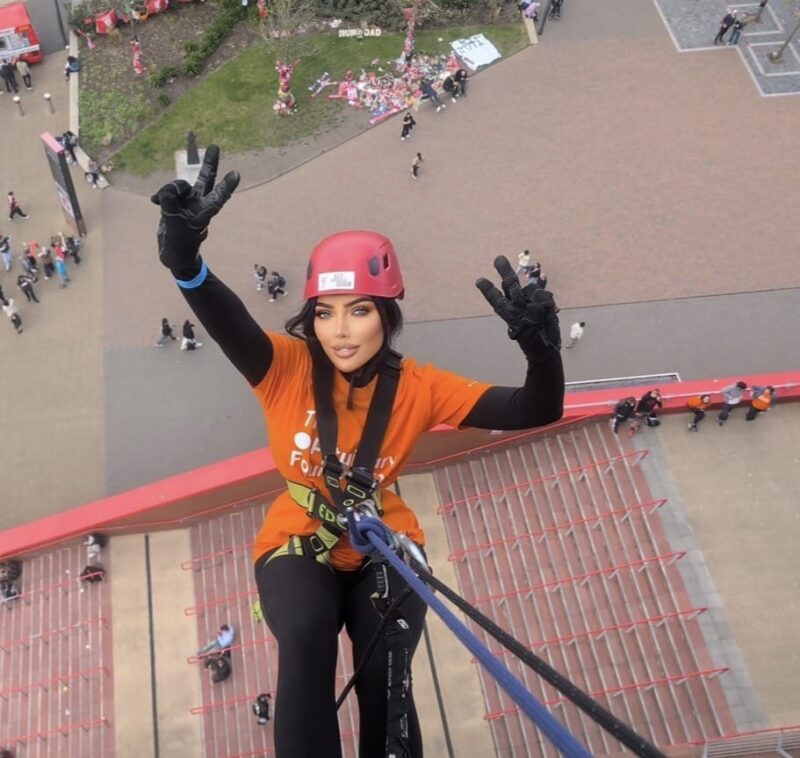
My Journey with Cushing’s disease
At 30 years old, I was fit, healthy and naturally a size 8–10. I knew my body well, which is why, when it started to


Everywhere I go these days I see the posters and promotion for Disney’s The Little Mermaid movie. The song “Part of Your World” loops through my head constantly.
I remember the exhilaration of seeing the original Disney movie for the first time as a little girl. Ariel knew who and what she was even if the world didn’t. The items she collected from the world in which she belonged were tangible representations she treasured.
When her transformation was complete, she was ushered into a place she knew long before her legs could carry her. She was home.
Yet, there was a part of her that also belonged to the sea. By the end of the film, she realized that she was loved and could choose to exist in one, and lovingly return to visit the other whenever her heart desired.
Menstruation has always been a topic closely guarded and used by some to manipulate and control people with uteruses for all time. It has even been used by some to usher young girls into “womanhood” and to keep men at bay.
But what about those who menstruate and do not fit into the mold of “woman”. Those who, like Ariel, know who they are and where they belong, but are often told they don’t. They still must access menstrual products that remind them every month that their existence is not validated in the way women are.
How do they feel about their periods? Their voices, as beautiful as Ariel’s, also deserve to be heard. Perspectives on nonbinary and trans menstruation offer insight that glitters like the sea. Let’s take a dive into their world!

Fitz is a transgender man (he was assigned “female” at birth). His pronouns are he/him. He began menstruating around the age of 12. When I asked if he would be willing to share, he immediately responded: “I’d love to share some experience and love.”
His answers to my questions astounded me. His honesty and obvious care for others warmed my heart.
“Sometimes it’s hard to explain ‘what makes me trans’. I was always upset about my body. I did whatever I could to hide it.
“My gender identity is not something I always knew. Growing up, I did not know what being trans was or meant. I remember in high school I started to hear about trans women, but sadly never in a good way.
“I knew I was different, but not how. Once I was able to discover more about the world in general, I finally learned who I really am.
“I am a gay, transgender man! Yes, we exist. Sexualality does not always correlate with gender. It took time to learn and research what all of this meant, and how I fit in with that.
“Living as my authentic self has opened so many doors for my mental health to succeed. I was very depressed and suicidal for a long time. Once I started hearing my name and pronouns daily, life really changed.”
“I hate menstruation. Young women are told to hide their period as much as possible. They are told to be secretive about taking products with them; to not show pain, discomfort, or moods.”
“I feel most comfortable around other queer people and the LGBTQIA+ community. Generally, I feel straight/cis people l take little to no time learning about us. There are strong allies in the world, and I am truly grateful for them.
“However, being in an environment where I am the only member of the LGBTQIA+ community poses challenges in many ways. I live in North Georgia and, in my experience, 90% of the time, if trans people are thought about, it’s in a negative way.
“If I happen to get my period when I am out and about I get into a predicament. You are not going to find a trash can in a men’s bathroom stall.”
“‘Pink Tax’ is a term I’ve heard numerous times. But there is so much more that people don’t think about.
“I am a very masculine presenting transman. When I have to go to the store and buy anything that has to do with ‘feminine care’ I get all of the stares. I have even gotten comments like ‘She’s really got you whipped into shape if you are coming to the store to buy that for her!’ Disgusting!
“If a trans person starts taking testosterone for transition, which I have, some symptoms are very similar to menopause. Hot flashes, changes in periods, and, what I want to address here: vaginal atrophy (which can lead to vaginismus). This is something that I experience.
“This pretty much eliminates the ability for me to use tampons, because of the pain and danger. So what does that leave me? Pads. I wear boxer briefs, which are the only type of underwear I own. This means I have to go buy and wear women’s underwear to accommodate a pad”
“Knowing who I truly am, having a period triggers my dysphoria more than anything else.”
“I have two big reasons to share. The first being, not many cis/straight people are going to search for this information. If I don’t share they simply will not know.
“The second is, there might be someone searching for this experience. I was lucky to learn who I am, and have found other transmen and learned from their experience.
“I want to share with the parents who are searching to help their kids, and the people whose friends just came out who want to support them the best way they can. Most importantly, for the trans people trying to learn about themselves.”
“Remember, it’s not just women who have periods. Trans and nonbinary people do too. Using the word ‘people’ makes such a huge difference in our lives.”
“Listening is the most important. Us trans people know what the cis-gender world is like. All we want is for people to listen to our experience so we can live in this world together, not separate.”
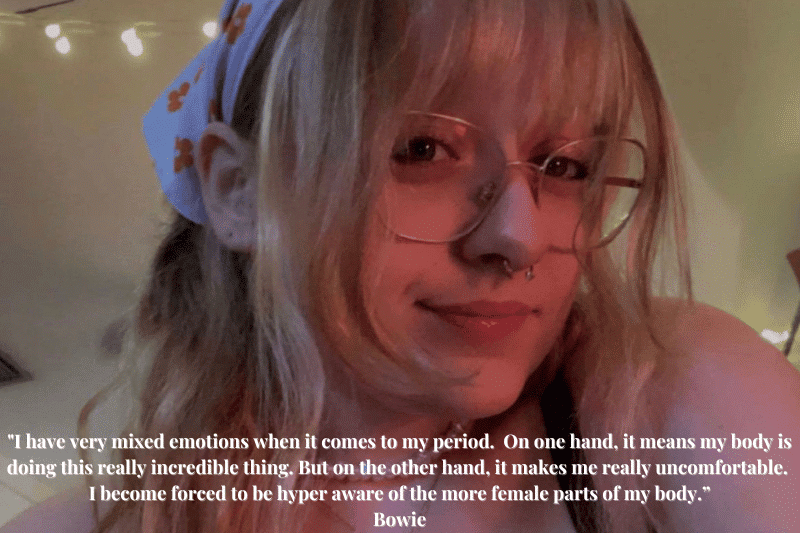
Bowie is a friend of mine. They are nonbinary and their pronouns are they/them. They began menstruating around the time I met them, at age 11.
Their answers broke my heart into a thousand pieces, because for as long as I have known them, I never truly knew what they have been through.
“Being nonbinary to me is a sense of comfort with not having to be either a boy or a girl. I am who I am, and I don’t have to fit into the boxes that ‘gender’ puts us into.
“I present more feminine. That is not because I am a girl, but because it is what makes me happy. I love that about myself and my identity.”
“I have very mixed emotions when it comes to my period. On one hand, it means my body is doing this really incredible thing. But on the other hand, it makes me really uncomfortable. I become forced to be hyper aware of the more female parts of my body, and periods just suck in general.”
“I feel most free and accepted when me and my pronouns are treated as something not out of the ordinary. People referring to me as ‘they’ or ‘them’ without even thinking makes me feel very accepted, as well as seeing inclusive wording in everyday things.
“I feel like menstrual products could be a lot more inclusive than they are now. Seeing all of the female symbols and phrases like ‘you go girl!’ on pads and tampons makes me feel like they’re not meant for me even though I am a person with a period. I also feel like there should be more options when it comes to products.”
Yes, 100%! A company I feel is doing really good with the packaging and inclusivity issue is called August. They do an amazing job by catering to everyone who has periods and not just cis-gender women. They make a real effort towards sustainability, reproductive rights, and period health and education. They also work to destigmatize periods. I highly recommend checking them out.”
“I feel it is important for people to see that it is not only cis-gendered women who experience periods. If a nonbinary person feels alone with their period I want them to be able to look and see that there are so many people like them dealing with similar issues. If I can make one person feel a little bit less alone then that is worth it to me.”
“I think that women in society can work on using less gendered terms when discussing menstruation. Saying things like ‘feminine hygiene products’ or ‘girls with periods’ isolates people who identify differently. Everyone who experiences a period knows how difficult it is, and feeling alone at that time only makes it worse.”
In the study, Outcomes of Menstrual Management Use in Transgender and Gender-Diverse Adolescents, which provided the first known data on outcomes of menstrual management use in transgender and gender-diverse adolescents, we learn: “Gender-affirming care can improve mental health symptoms and outcomes. Because gender-diverse patients frequently report increased dysphoria with menses and desire amenorrhea, menstrual management is an important component of gender-affirming care.”
Fitz shared with me one of his most memorable take-aways from the mermaid film. He realized that in order for the mermaid to live her most authentic self she had to give up her voice. He says that is often true in real life for those who are nonbinary or trans.
In this article, we amplify the voices of real people who experience menstruation. Its impact on their lives is everything cis-gender women experience, and more. What is a minor inconvenience for some can be an attack on the life of others.
Each conversation and period product has the power to be a tangible representation. Listening, acknowledging, and changing are ways we can show that we are all part of this world.
Schwartz, B. I., Bear, B., Short, V. L., & Kazak, A. E. (2023). Outcomes of Menstrual Management Use in Transgender and Gender-Diverse Adolescents. Obstetrics and Gynecology, 141(4), 748–755. https://doi.org/10.1097/AOG.0000000000005123

At 30 years old, I was fit, healthy and naturally a size 8–10. I knew my body well, which is why, when it started to
If you’ve had more than one loss, you may already have had chromosome testing, a karyotype or carrier screening, and still no answer. Here is
I am 36 years old, and I have spent a large part of my life trying to understand my own body and trying to become

