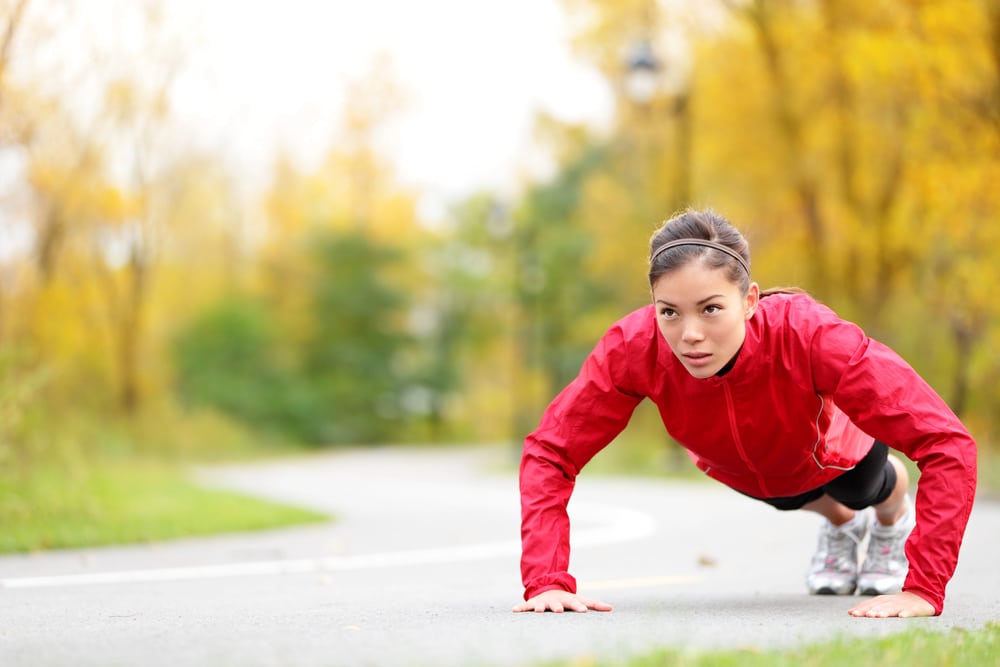
Dip into social or print media and you’ll see headlines like: “Strong Is The New Pretty”, “Real Women Lift Weights”, and “Lift Heavy Or Go Home”. Women gaining muscle has never been sexier. Strength training is touted as key for preventing ageing, fatigue, muscle mass and bone loss, and additional symptoms of menopause.
Lifting weights can definitely shape your body and increase muscle mass. But should we all be pumping iron? If that’s not your thing, I have good news. There is more than one way to strength train!
Different types of strength training
Weight lifting works on the principle of Muscle Overload Training and/or Progressive Muscle Overload, meaning to contract muscle against opposing force so it breaks down (this is what makes us sore) and rebuilds bigger and better. More opposing force each time and the muscle grows faster. It works.
You can also load your muscle with any form of resistance, like gravity, your own body weight, other people’s body weight, grocery bags, laundry baskets, a push lawn mower, bags of mulch, babies, elastic bands, springs, water resistance (hello pool aerobics), or any other machine or object to increase the workload. This gives a multitude of ways to challenge your muscles other than pumping iron… unless you want to pump iron.
How else can you encourage strength without lifting heavy? Repetitions, frequency, pace, and most of all, consistency. Repeat exercises. Do them slower (or quicker) to challenge different kinds of muscle fibers, add sessions to the week, and keep going! Don’t expect a huge difference in a short amount of time. If you have muscle or joint pain, you’ll be more consistent if you don’t trigger a pain spiral.
More good news: Postural muscles count in your total mass! Pelvic floor exercises and balance training drills? They strengthen postural muscles which count in increased lean tissue mass that you won’t see as bulk. Bonus: They reduce present and future fall risk . If your estrogen is declining or you have prolapse, you need to pay attention to this!
Pilates is my favourite choice. It’s easy to vary resistance with props or springs, builds in breathing, pelvic floor, and postural muscles, as well as flexibility to keep muscles long, not bulky. Pilates is challenging without feeling punishing, pacing changes depending on the exercise, and though you can keep repetitions low, the same muscle groups are challenged repeatedly to encourage gains. It’s fun and group classes are social, adding to the health benefits.
Interesting Pilates fact:
A fully-loaded, studio-grade Reformer at full spring extension (depending on the manufacturer) can give you around 200 pounds/91 kilos of resistance! Source: balanced body.com
How strong is strong enough?
You don’t need charts and measures. Can you see some muscles on your body? Are they balanced and relatively symmetrical? More importantly, can you perform all the activities of daily living and your chosen exercise or sport fairly easily? Do you have enough energy for those tasks so you don’t feel like a noodle after effort? If your answer is mostly no, it’s time to challenge your body. If you say yes to most of those, chances are that you are already pretty strong. Keep going! Muscles atrophy when they aren’t used!
If you like guidelines, aim for two strength-focused workouts a week. Add more to see more. I recommend adding a weekly session specifically for balance to include the reactive posture muscles. For additional benefits don’t forget to mind your breath and pelvic floor no matter what the focus of the exercise!
To answer the question in the title, choose what you like and go it regularly, including the more challenging activities of daily living!
References:
Churchward-Venne, T. A., Tieland, M., Verdijk, L. B., Leenders, M., Dirks, M. L., De Groot, L. C., & Van Loon, L. J. (2015). There are no nonresponders to Resistance-Type exercise training in older men and women. Journal of the American Medical Directors Association, 16(5), 400–411. doi.org/10.1016/j.jamda.2015.01.071
Fyfe, J. J., Hamilton, D. L., & Daly, R. M. (2021). Minimal-Dose resistance training for improving muscle mass, strength, and Function: A narrative review of current evidence and practical considerations. Sports Medicine, 52(3), 463–479. doi.org/10.1007/s40279-021-01605-8
Pilates Reformer Springs – Balanced Body Reformer Springs. (n.d.). Balanced Body, Inc. pilates.com/products/pilates-reformer-signature-springs/
U.S. Department of Health and Human Services, & Burwell, S. M. (2018). Physical activity guidelines for Americans. In U.S. Department of Agriculture, Executive Summary. health.gov/sites/default/files/2019-10/PAG_ExecutiveSummary.pdf
What is progressive overload training? (2020, July 30). Healthline. healthline.com/health/progressive-overload#ways-to-do-it